
Ephesus
The best preserved classical city on the Mediterranean, and one of the hardest places in Türkiye to be heard in. A working guide's read of the site: the walking order, where groups lose the thread, and what the acoustics actually do.
- Location
- Selçuk, İzmir
- Type
- Ancient city
- Typical visit
- 3 h
- Walking time
- 1 h 20 min
- UNESCO
- World Heritage List, 2015
- Coordinates
- 37.9397, 27.3417
Summarize with AI:ChatGPTClaudePerplexityGrokGoogle AI Mode
Ephesus was the capital of Roman Asia and held something like a quarter of a million people. What survives is the reason it is on almost every western Türkiye itinerary: a marble street grid you can still walk, a library facade rebuilt to its full two storeys, and a theatre that seated 24,000. It was inscribed on the UNESCO World Heritage List in 2015.
Excavation has run for over 150 years and roughly four fifths of the city is still underground. That matters for narration more than it sounds: almost everything your group sees is public, civic architecture. The housing, the workshops and the ordinary streets are still buried, so the site reads as grander and emptier than the city ever was.
Why this site is difficult to guide
Ephesus is a linear, downhill site with two gates. That is a gift for logistics and a problem for voice. The group spreads along a marble avenue, the walls that would hold your voice are gone, and the surface reflects sound upward instead of back at the people behind you. By the time a group of thirty is strung out along Curetes Street, the people at the back are getting weather, not narration.
The second problem is competition. Ephesus takes cruise traffic from Kuşadası, which means several groups arrive within minutes of each other and stand in the same three places. You are not only fighting distance, you are fighting four other guides within earshot.
The walk, in the order that works
Start at the Upper Gate and walk down. Both gates are open, and starting at the bottom means walking a group uphill on hot marble at the end of the visit, when they are least willing. Downhill also puts the theatre and the lower gate at the end, so the walk finishes where the coaches wait rather than doubling back.
What to say, and where
The Library of Celsus is the photograph everyone came for, so it is also where you will lose their attention. Give the story before you arrive, on the walk down Curetes Street, and let the facade itself be the pause. The library held around 12,000 scrolls and was the third largest in the ancient world; it was built as a tomb as much as a library, and Celsus is buried under it.
The Great Theatre is the one place on the site where the architecture works with you instead of against you. It was built to carry an unamplified voice to 24,000 people and it still does. Stand on the stage floor, not on the steps. This is also where Acts places the silversmiths' riot against Paul, which is the single most requested stop for pilgrimage groups.
The Temple of Artemis, one of the seven wonders, is not on this walk. It is a single standing column in a field outside the site. Say so before someone asks, or you will answer it five times.
Practical notes
- The Terrace Houses are a separate ticket and worth it, but they add roughly 45 minutes and the walkways are narrow, so a large group has to split.
- The Museum of Ephesus is in Selçuk, about 3 km from the site, and is where most of the movable finds ended up.
- There is very little shade. In summer the marble becomes uncomfortable by late morning.
The Terrace Houses exclusion is not our reading of the rules -- it appears on the Ministry’s own product page for every museum card. Which card covers what, and the other places where none of them work, is on our museum cards page.
Walking order
The order we use, with the time each stop takes at a normal group pace.
Upper Gate and the Odeon
The state agora, the Odeon and Domitian Square. The natural place to set the scene before the group starts walking downhill.
Curetes Street and the Library of Celsus
The Temple of Hadrian, the Terrace Houses and the library facade. The longest stop, and the most crowded one.
Great Theatre and Harbour Street
The Arcadian Way and the 24,000-seat theatre. Ends near the lower gate, so the walk finishes where the coaches wait.
3 stops · 1 h 20 min
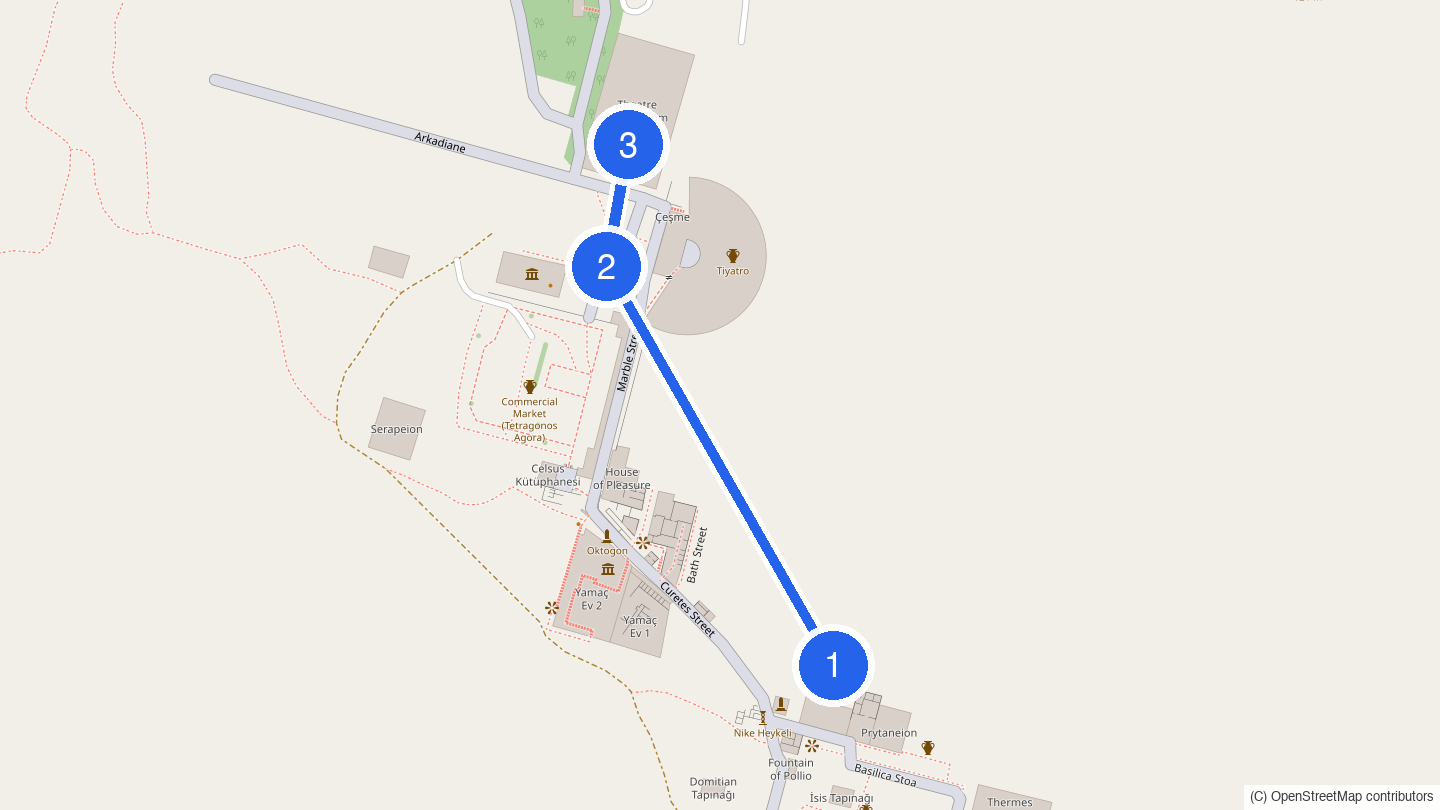
37.9397, 27.3417
Coordinates are for orientation, not for navigation.
Map data © OpenStreetMap contributors.
Notes for guides
What a guide needs to know before standing in front of a group here. Written from our own field work; where we have not verified something, it is not listed.
- RouteWalk downhill from the Upper Gate. Ending at the lower gate puts the group at the coaches instead of walking them back up hot marble.
- Being heardCuretes Street is where a group of thirty stretches out and the back half stops hearing you. Deliver the Celsus story on the move, before the facade, while people are still bunched.
- Being heardThe Great Theatre is the only stop with real acoustics. Stand on the stage floor; from the steps your voice goes over their heads.
- CrowdsExpect several groups in the same three spots at once. Cruise arrivals from Kuşadası cluster in the late morning.
- AccessThe Terrace Houses need a split for large groups: narrow walkways, single file, roughly 45 extra minutes.
- TipSay early that the Temple of Artemis is not inside the site, otherwise you answer it repeatedly.
Photographs
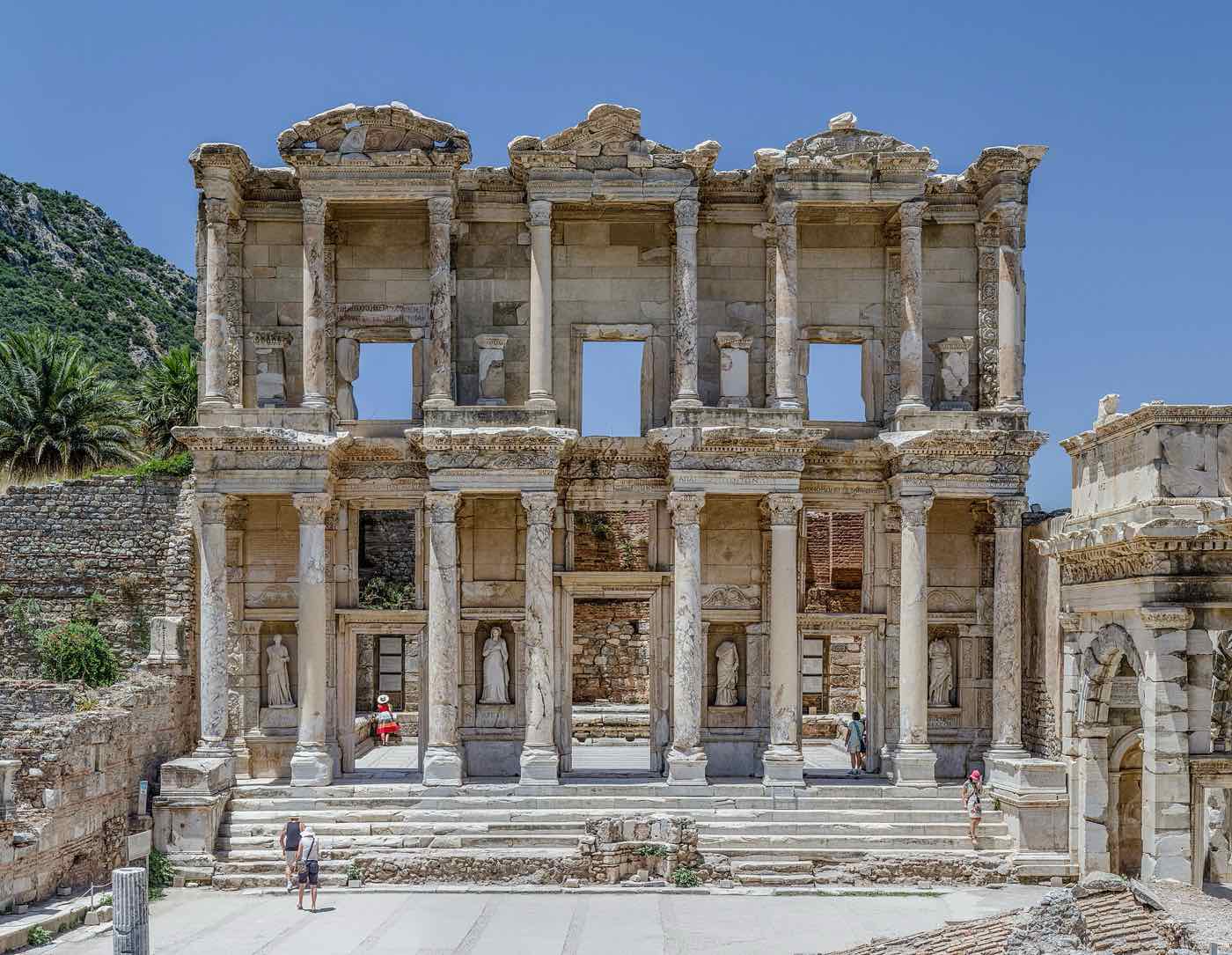
Photo: Benh Lieu Song (CC BY-SA 3.0)
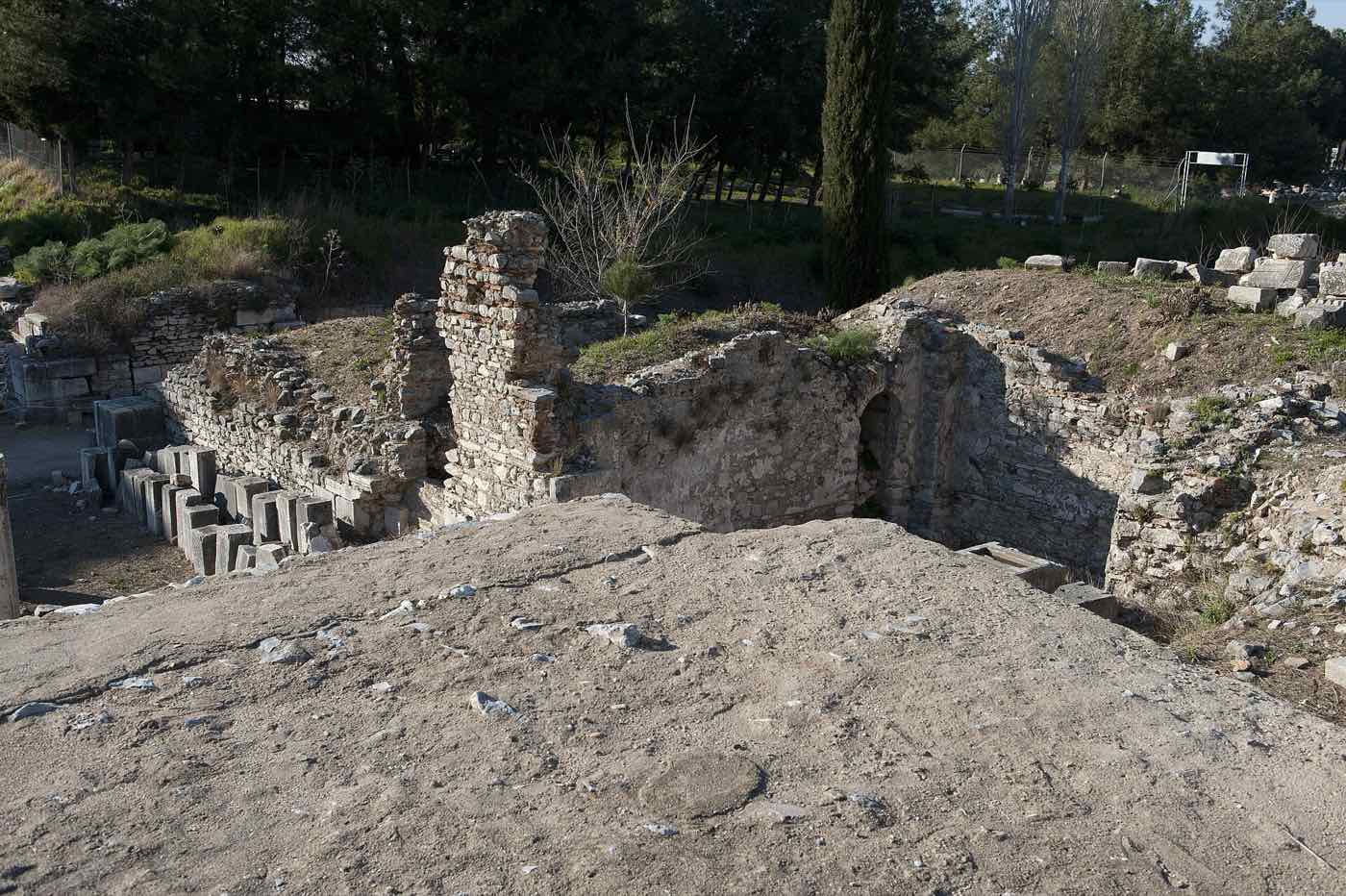
Photo: Dosseman (CC BY-SA 4.0)
Common questions
- How long does a guided visit to Ephesus take?
- Around three hours walking from the Upper Gate to the lower gate at a normal group pace, including stops. The Terrace Houses add roughly 45 minutes and a separate ticket.
- Should you start at the upper or the lower gate?
- The Upper Gate. Walking downhill keeps the group together, and the visit ends near the lower gate where the coaches wait instead of climbing back up in the heat.
- Why is it hard to be heard at Ephesus?
- The site is linear and open. Groups stretch along Curetes Street, the enclosing walls are gone, and the marble reflects sound upward. Several groups also occupy the same viewpoints at once, especially late morning.
- Is the Temple of Artemis part of the Ephesus site?
- No. It stands outside the archaeological site near Selçuk and today is a single re-erected column, so it is usually a short separate stop rather than part of the walk.
Related articles
Sources
Facts on this page come from the sources below. Photographs are credited individually.