
How do you guide a group that does not share a language?
Summarize with AI:ChatGPTClaudePerplexityGrokGoogle AI Mode
A group where half speaks English and half speaks German is a normal booking, not an edge case. The standard solution -- deliver each explanation twice -- has a cost that is easy to underestimate.
It is not that the tour takes twice as long. It is that during each pass, half the group has nothing to do. They start their own conversations, and by the second pass you are competing with the noise your own method created.
What does saying everything twice actually cost?
Three things, and only the first is obvious.
| Cost | What it looks like | Why it compounds |
|---|---|---|
| Time | Each stop takes roughly double | You cut content, usually the best content |
| Attention | Half the group disengages every pass | They are harder to bring back each time |
| Noise | Waiting participants talk | The second pass is delivered over chatter |
The third one is the reason experienced guides shorten the second version. That is understandable and it means one language group is systematically getting a worse tour.
When does splitting the group work?
When you have a second guide. With two guides and two languages, splitting is clearly right: both halves get a full tour at full pace.
With one guide, splitting means one group waits somewhere while the other is guided, which is worse than repetition for everyone involved. At a busy site it also means the second group meets different crowd conditions at every stop.
- Ask for language in the booking, not nationality -- a Dutch participant may prefer English, and a Turkish resident may prefer German.
- Ask again in the pre-tour message, because bookings are often made by one person for several people.
- Decide before arrival whether you are repeating, splitting, or translating. Deciding at the meeting point costs the first stop.
- If you repeat, alternate which language goes first at each stop. The second pass always gets less energy; spread that cost evenly.
- Give the regroup point in every language you are using, every time.
How does live translation change the arithmetic?
It removes the second pass. You speak once, in your own language, and each participant hears the tour in the language they picked -- delivered to their own phone alongside live captions they can read.
That changes the shape of the stop rather than just its length. Nobody is waiting, so nobody starts a side conversation, so the noise problem never appears. The group also stops sorting itself into language clusters, which in our experience is the difference between one tour group and two that happen to be walking together.
Frequently asked questions
How many languages can one group use at once?
Do participants need to install anything?
Are captions available as well as audio?
Should I still repeat key names?
What if two participants want the same rare language?
Speak once, let everyone hear their own
If mixed-language bookings are a regular part of your work, the repetition tax is probably costing you more content than you realise. See how live translation works, or check what is included on the pricing page.
Sources
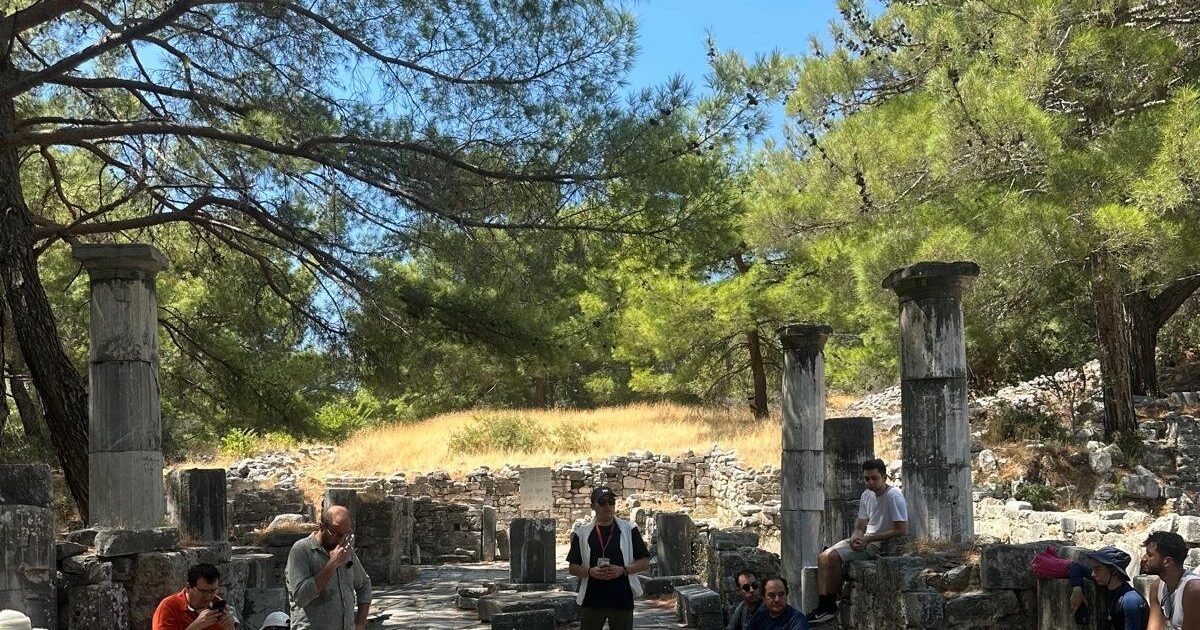
Group-behaviour observations come from our own field tests on the Aegean coast and in southeastern Türkiye. Photograph is our own. Live translation and caption behaviour describe the Your Next Tours system as shipped in 2026.
Related articles
 GuidesHeadsets are mandatory for Florence tour groups of more than eight (2026)
 GuidesYour group has scattered across a site. Now what?
 GuidesDoes a tour audio system work underground? Signal, stone and what to carry
 GuidesHow do you make a guide's voice heard in wind? What actually gets lost
 GuidesCan a guide narrate out loud inside a museum? What the rules actually restrict
 GuidesHow to guide a 40-person group through an archaeological site in 2026