How to guide a 40-person group through an archaeological site in 2026
Summarize with AI:ChatGPTClaudePerplexityGrokGoogle AI Mode
A large group at an ancient city is not a small group with more people in it. Past roughly twenty-five participants the failure modes change: you stop losing individuals and start losing the back third, permanently, at every stop.
The cause is a single physical number. An unaided speaking voice carries about six metres outdoors before wind, distance and competing groups make it unintelligible. Forty people standing comfortably occupy considerably more ground than that. Everything below follows from that mismatch.
Where does a large group actually break down?
Not where guides expect. The group rarely scatters on the open path -- people follow the person in front of them. It breaks at stops, because a stop is where the group converts from a line into a cluster, and the cluster is wider than your voice.
The second failure point is any narrowing: a gate, a stair, a colonnade. The front passes through and keeps walking; the back is still queueing. By the time the back arrives, the front has heard half an explanation and the back has heard none.
| Situation | What the back third experiences | What it costs you |
|---|---|---|
| Open-air stop, 40 people | Hears fragments, watches your gestures | The story, and their attention for the next stop |
| Single-file passage | Arrives after the explanation | A repeat, or an unexplained ruin |
| Competing group nearby | Hears the other guide more clearly than you | Confusion about which group they are in |
| Wind across open ground | Hears consonants drop out first | Names and dates, which is most of the content |
What walking order keeps forty people together?
Stop selection does more work than pace. Choose positions where the group can form an arc around you with their backs to the noise source, and where the thing you are describing is behind you rather than behind them.
- Brief before every narrowing. If the next hundred metres is single file, say what they are about to see while they are still a cluster.
- Put your back to the wind and the group's back to the neighbouring group. Sound is directional and so is distraction.
- Stop before the interesting thing, not at it -- at it, half the group is looking past you and the other half is taking photographs.
- Name the regroup point out loud at each stop. "We meet at the theatre steps" survives a group splitting; "stay with me" does not.
- Count at transitions, not continuously. Two counts per site beats forty glances over your shoulder.
What did a real 40-person test look like?
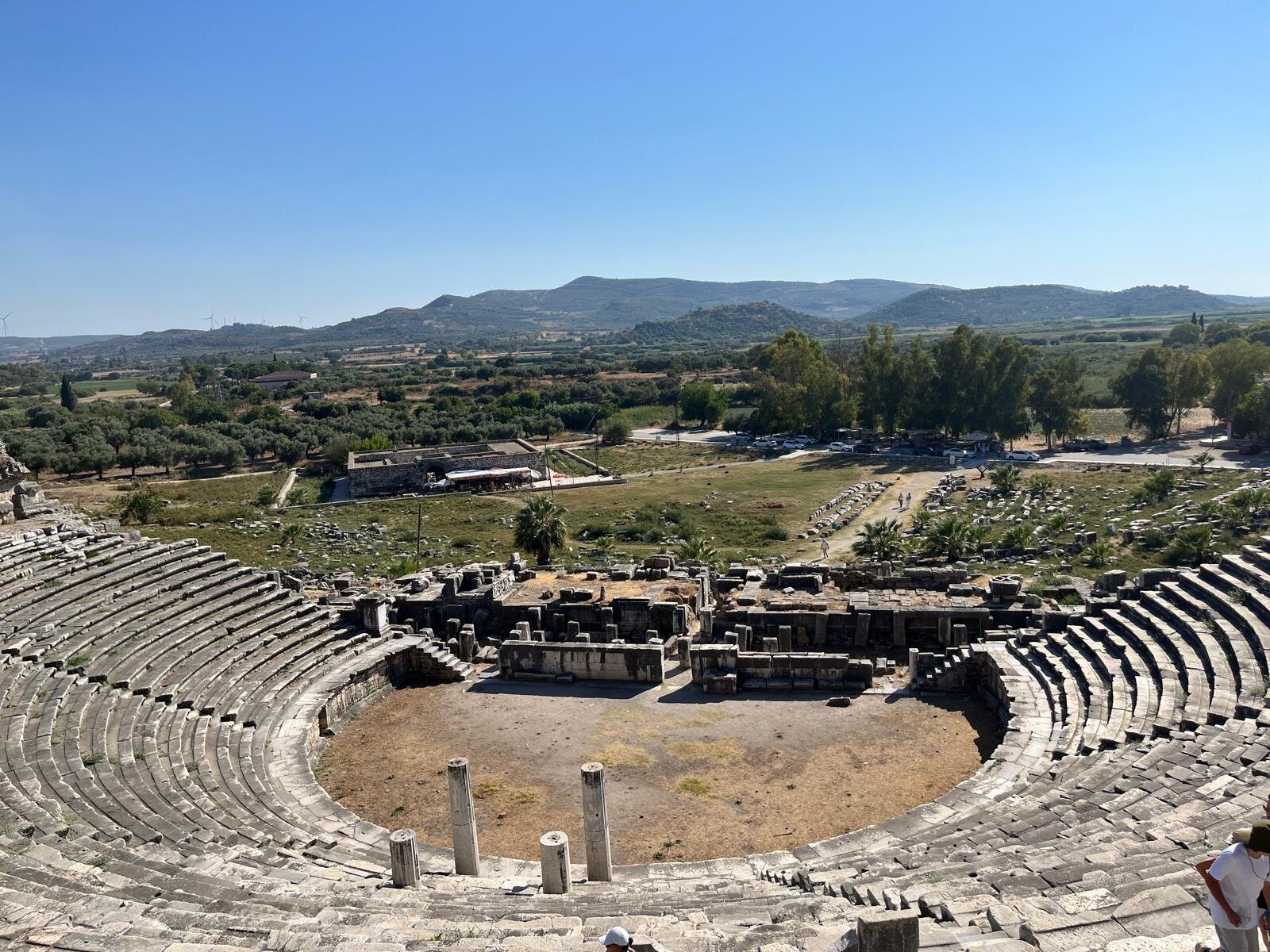
We ran a full tour at Göbeklitepe and Karahantepe with forty participants, no rented receivers and no internet connection on site. The finding that surprised us was not about audio quality; it was about distance tolerance.
With everyone hearing the guide in their own earphones, the group stopped compressing toward the guide. People stood where they could see, not where they could hear, and the useful group radius went from about six metres to the width of the enclosure. The guide stopped repeating himself, which recovered more time than any pacing change we tried.
Frequently asked questions
At what group size do these problems start?
Does splitting into two smaller groups solve it?
Do participants need to install anything?
Does it work where there is no mobile signal?
How many people can listen at once?
Try it on your next large group
The walking-order habits above work with any equipment, or none. If the constraint you keep hitting is the six-metre one, see how the broadcast works -- your phone becomes the transmitter and participants listen in their own earphones. Plans and limits are on the pricing page.
Sources
Group-size observations come from our own field tests at Göbeklitepe and Karahantepe (40 participants) and on the Aegean coast at Ephesus, Miletus and Didyma. Photographs are our own. Broadcast capacity figures describe the Your Next Tours system as shipped in 2026.