Troy
The citadel is under 200 m across. Everything a group came for happens inside that, which makes Troy the rare site where the problem is not distance but expectation.
- Location
- Tevfikiye, Çanakkale
- Type
- Ancient city
- Typical visit
- 1 h 30 min
- Walking time
- 1 h 5 min
- UNESCO
- World Heritage List, 1998
- Coordinates
- 39.9574, 26.2380
Summarize with AI:ChatGPTClaudePerplexityGrokGoogle AI Mode
Troy was inscribed on the UNESCO World Heritage List in 1998. The mound at Hisarlik holds nine successive settlements stacked on top of each other, spanning roughly four thousand years, and the visit is essentially a walk around and through that stack.
The thing to know before you bring a group is the scale. From the wooden horse at the entrance to the east tower is about 106 m. From the east tower to the Schliemann trench is another 104 m. The citadel itself is under 200 m across, and the whole visitor circuit including the horse is about 250 m. Groups arrive expecting a city and find a mound.
The walkway decides your route
Visitors move on a raised timber walkway that loops the mound. That is a gift and a constraint at once: you cannot lose people down a side path, but you also cannot stop wherever you want, because the walkway is narrow and other groups are behind you.
So the route is fixed and the only variable is where you stop. Three stops is the right number -- the entrance, the east wall, and the trench -- and each of them needs to be somewhere the walkway widens enough for a group to gather without blocking it.
The expectation gap is the real work
Nothing here looks like the story attached to it. The famous objects are elsewhere: Schliemann's 1873 find left the country and the bulk of it is in Moscow. What stands is fortification wall, a trench cut through the layers, and foundations.
That gap is the content, not a problem to apologise for. The layers in the trench are the argument -- they are why anyone believes a real city stood here at all. Say that at the trench rather than at the horse, where the group is still looking for a movie set.
Practical notes
- The citadel is under 200 m across and the whole circuit about 250 m; the walk is short and the site is flat.
- Visitors follow a raised timber walkway, so the route is set for you.
- The mound sits on an open plain with nothing upwind of it.
- The Troy Museum is just under 1 km away and holds the finds.
- Spring and autumn are the workable seasons; there is almost no shade on the mound. Çanakkale's average high in July is 30.9 °C, and December and January each average 12 rainy days.
The finds are at the Troy Museum, a kilometre down the road.
Walking order
The order we use, with the time each stop takes at a normal group pace.
Entrance and the wooden horse
The assembly point before the walkway starts.
The east wall and tower
The best-preserved stretch of Bronze Age fortification.
The Schliemann trench and the megaron
The cut through the mound where the layers are readable.
3 stops · 1 h 5 min

39.9574, 26.2380
Coordinates are for orientation, not for navigation.
Map data © OpenStreetMap contributors.
Notes for guides
What a guide needs to know before standing in front of a group here. Written from our own field work; where we have not verified something, it is not listed.
- RouteEntrance, east wall, trench. The walkway loops, so you do not choose the order -- you only choose where to stop, and it should be where the deck is wide enough to gather without blocking it.
- Being heardThe mound stands on an open plain with nothing to break the wind off the Dardanelles. This is a site where a raised voice is lost sideways rather than carried.
- CrowdsThe walkway is narrow and one-directional in practice. A group that stops in the wrong place holds up everyone behind it, so pick your stops before you start.
- TimingNinety minutes covers the mound properly. Spring and autumn: there is no shade up there and no shelter from the wind either.
- TipMake the trench the place where you explain the layers, not the entrance. At the horse the group is still looking for something that was never here.
Photographs
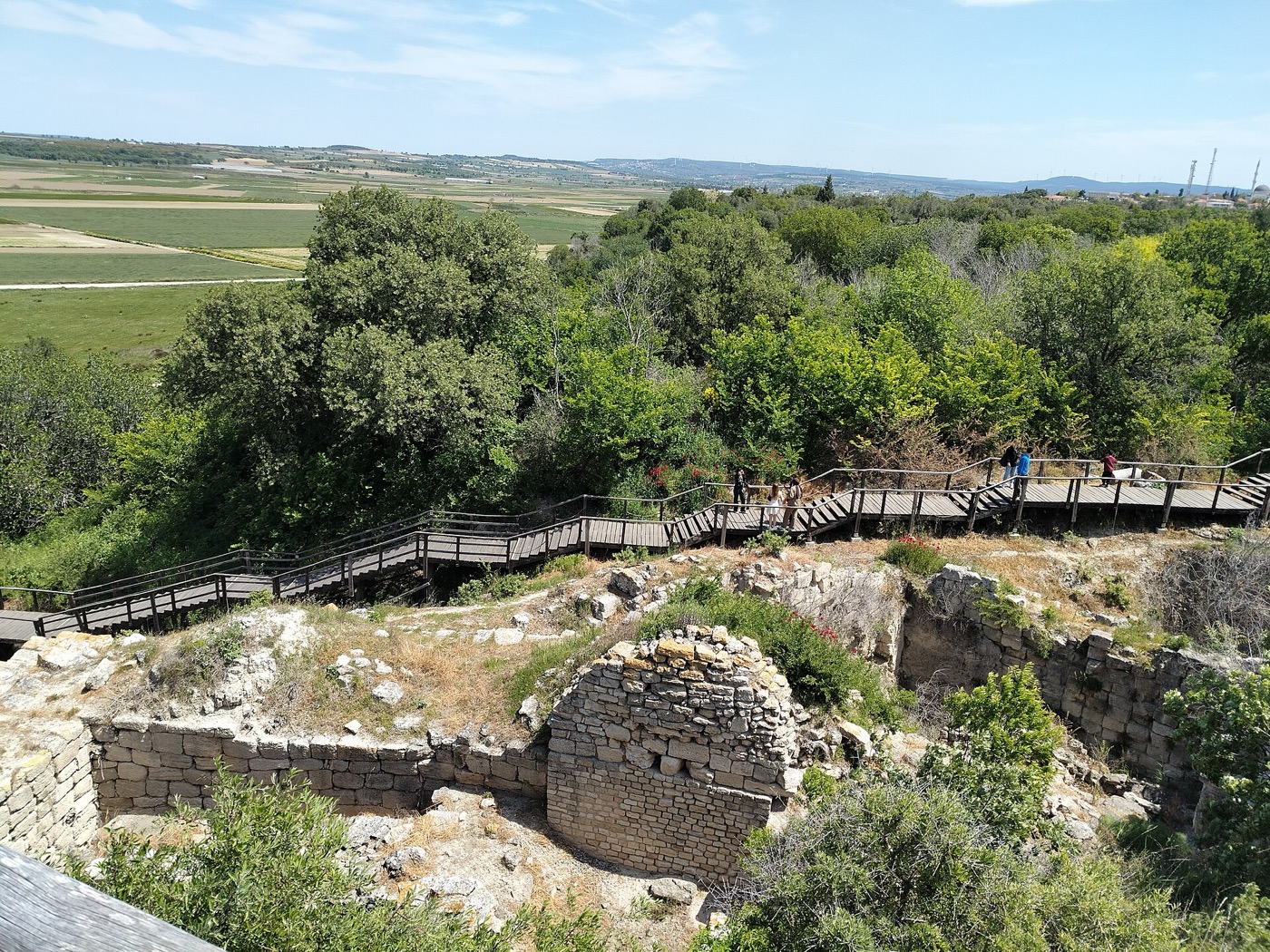
Photo: Barrowbob (CC BY-SA 4.0)
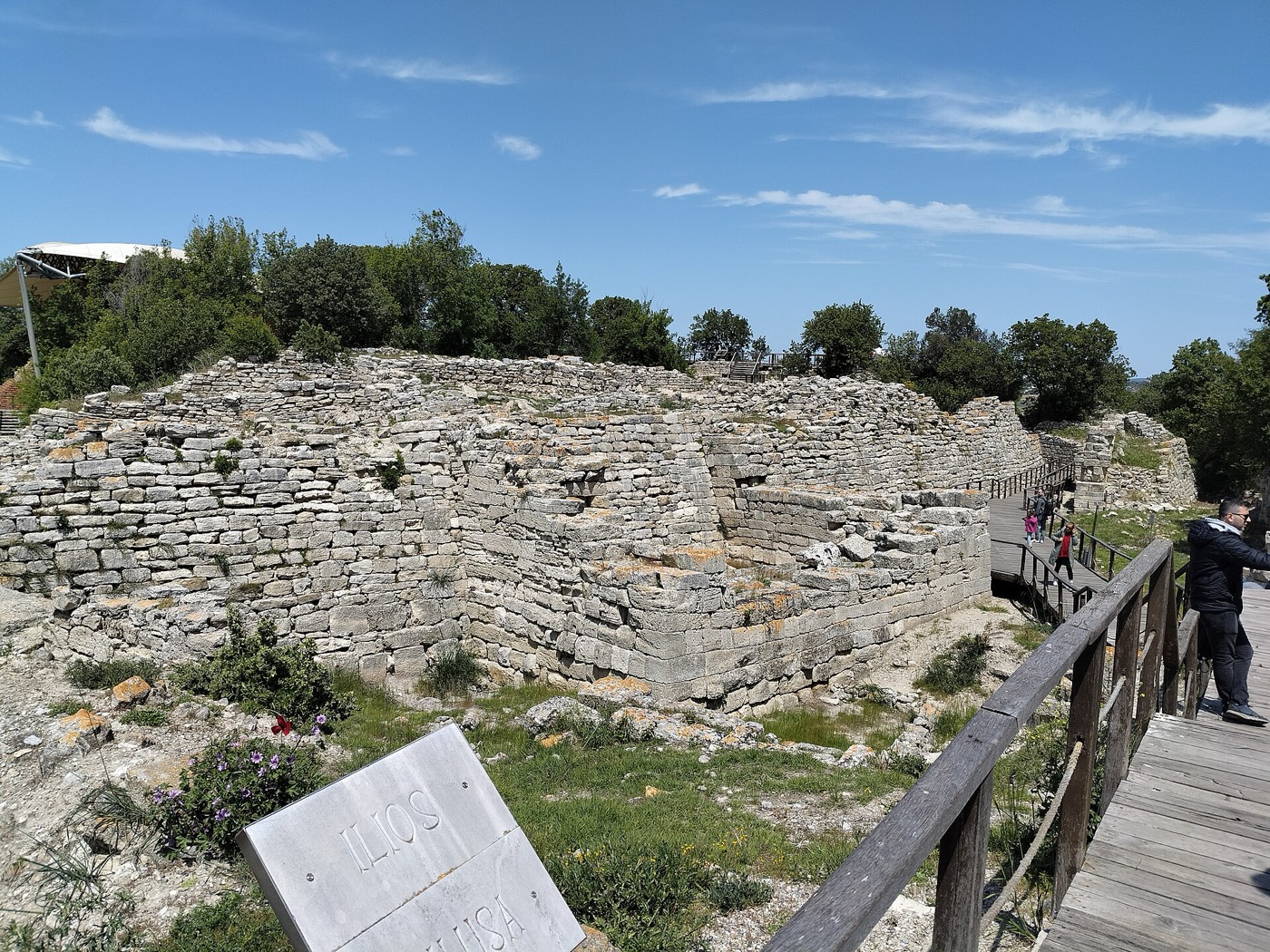
Photo: Barrowbob (CC BY-SA 4.0)


Common questions
- How big is the archaeological site of Troy?
- The citadel is under 200 m across, and the whole visitor circuit including the wooden horse about 250 m. From the horse to the east tower is roughly 106 m, and from there to the Schliemann trench another 104 m. It is a small, flat site.
- How long does a group need at Troy?
- About ninety minutes for the mound itself. Add the Troy Museum, just under a kilometre away, and it becomes a half day.
- Where is Priam's Treasure?
- Not at Troy. Schliemann's 1873 find left the country and the bulk of it is held in Moscow. What you see on the mound is fortification wall, foundations and the excavation trench through the layers.
- Is Troy a UNESCO World Heritage Site?
- Yes, the archaeological site of Troy was inscribed in 1998.
Related articles
Sources
Facts on this page come from the sources below. Photographs are credited individually.
- UNESCO World Heritage List, Archaeological Site of Troy (1998)whc.unesco.org
- Wikidata Q22647wikidata.org
- Pushkin State Museum of Fine Arts, Room 3: Ancient Troy and Schliemann's excavations (Treasure A: 101 of 183 objects in Moscow)arts-museum.ru
- Wikidata Q304483 (Priamos Hazinesi, bulunuş 1873)wikidata.org
- Meteoroloji Genel Müdürlüğü, Çanakkale uzun yıllar istatistiklerimgm.gov.tr
- OpenStreetMap, Troya'nin Arkeolojik Alani (durak koordinatlari)openstreetmap.org