Pergamon Acropolis
A capital built on a cone. Everything worth seeing is on a different terrace from everything else, and the group is always either above you or below you.
- Location
- Bergama, İzmir
- Type
- Ancient city
- Typical visit
- 2 h 30 min
- Walking time
- 1 h 10 min
- UNESCO
- World Heritage List, 2014
- Coordinates
- 39.1321, 27.1843
Summarize with AI:ChatGPTClaudePerplexityGrokGoogle AI Mode
Pergamon was the cultural capital of the Hellenistic world and its acropolis is stacked up the side of a cone above modern Bergama. The library held some two hundred thousand scrolls and rivalled Alexandria — parchment takes its name from this city because of that rivalry.
The site entered the UNESCO World Heritage List in 2014 as a multi-layered cultural landscape, which is why the Asklepion down in the valley belongs to the same inscription.
Why this site is hard to guide
Pergamon is not a walk, it is a descent. The terraces are stacked vertically and the connections between them are steep, so a group is never on one level: half of them are on the terrace above you and half on the one below, and the ones below cannot see your face.
The cable car adds a second problem at the start. It carries the group up in cabin-sized batches, so you do not begin with everyone in front of you — you begin with a queue arriving in pieces over ten or fifteen minutes. Decide before you go up where the group re-forms, and say it at the bottom.
The theatre is a safety decision, not a viewpoint
The theatre at Pergamon is the steepest of any in the ancient world: ten thousand seats pressed into a slope that falls away below the terrace. It is the single most photographed thing on the acropolis and the single most tempting place to lose control of a group.
Narrate it from the top. The seating is worn stone with no handrail on the descent, the rows are narrow, and a group strung down the cavea is out of earshot and out of sight at the same time. The view from the upper terrace is the view people came for; going down adds risk and takes twenty minutes.
What to say, and where
The Trajaneum carries the Roman layer and the sense of altitude: it is white marble at the highest point, and the group has just arrived, so this is where the scale lands.
The library is where the parchment story belongs, standing next to what is left of it. And the empty foundation of the Zeus Altar is where you explain that the altar itself is in Berlin. Say this early, at the Trajaneum, rather than at the foundation — the same rule that applies to the Market Gate at Miletus, and for the same reason: the question is better answered before the group is standing on the disappointment.
Practical notes
- MüzeKart is valid at the Pergamon acropolis.
- The cable car runs from the town centre and takes about five minutes; vehicles can also reach the upper car park.
- The terraces are marble and stone, and they get severely hot in summer afternoons.
- The Asklepion and the Bergama Museum are part of the same day and the same UNESCO inscription.
- The Zeus Altar is not on site; its foundation is.
The acropolis is covered by the museum pass. Our museum cards page sets out which card covers what.
Walking order
The order we use, with the time each stop takes at a normal group pace.
The Trajaneum
The Roman marble terrace at the top of the acropolis, and the first place the group sees how high they are.
The Theatre
Ten thousand seats on the steepest slope of any ancient theatre. Stand at the top; do not send the group down.
Library and Sanctuary of Athena
The remains of the library that rivalled Alexandria, beside the Athena precinct.
3 stops · 1 h 10 min

39.1321, 27.1843
Coordinates are for orientation, not for navigation.
Map data © OpenStreetMap contributors.
Notes for guides
What a guide needs to know before standing in front of a group here. Written from our own field work; where we have not verified something, it is not listed.
- AccessThe cable car delivers the group in cabin-sized batches. Name the regrouping point at the bottom station, before anyone gets in.
- RouteWork downhill from the Trajaneum. The terraces are stacked, and climbing back up between stops is where the time goes.
- AccessNarrate the theatre from the upper terrace and do not take a group down the cavea. The stone is worn, the rows are narrow and there is no handrail.
- Being heardOn a terrace the people below you cannot see your face, and a hilltop has nothing to block the wind off the plain. This is not a site where an unaided voice reaches the back.
- TimingSummer afternoons on white marble at altitude are punishing. Morning is the workable slot, which also puts the theatre in better light.
- TipSay at the Trajaneum that the Zeus Altar is in Berlin. Otherwise the question lands at an empty foundation.
Photographs
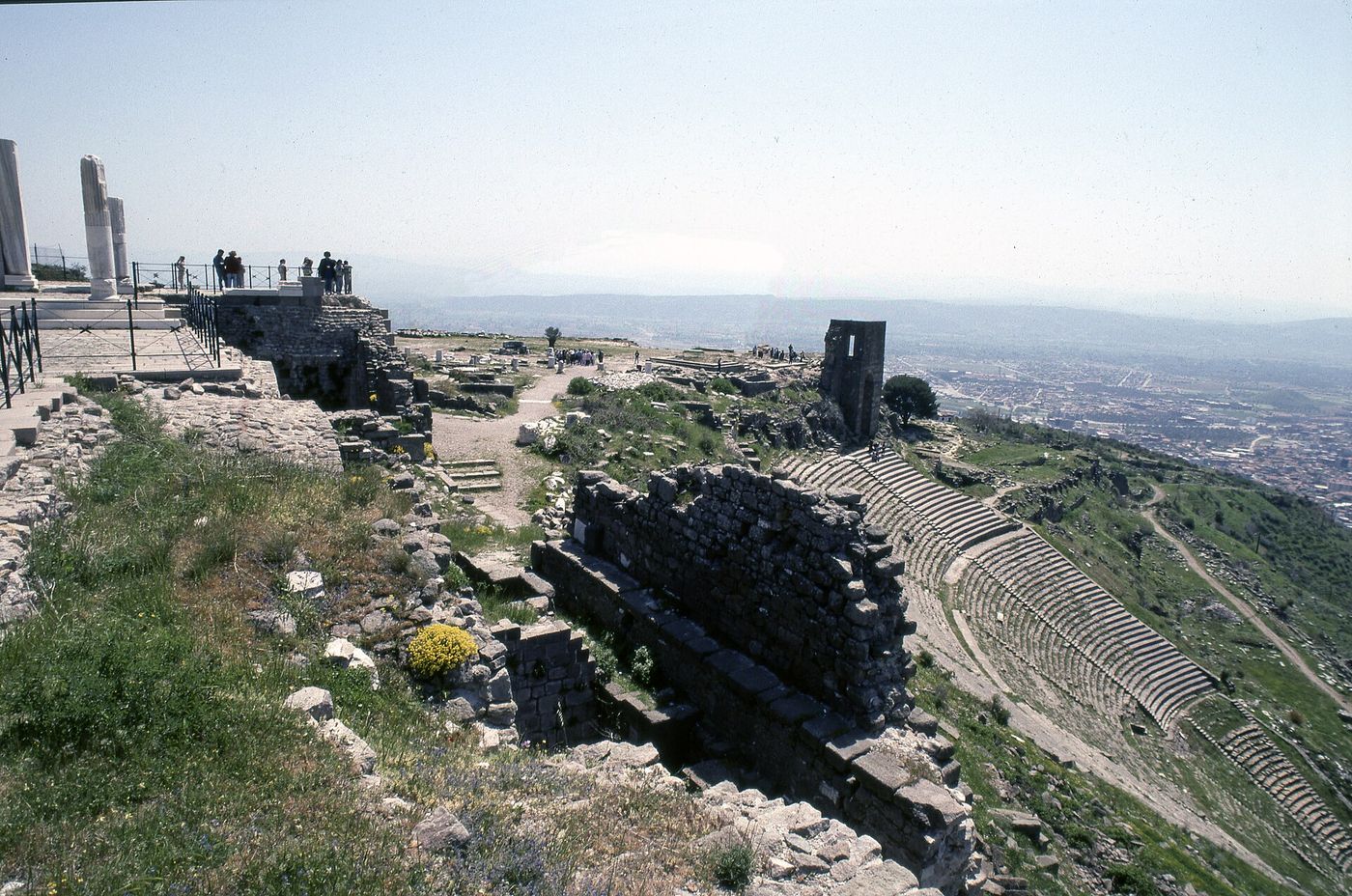
Photo: Dosseman (CC BY-SA 4.0)
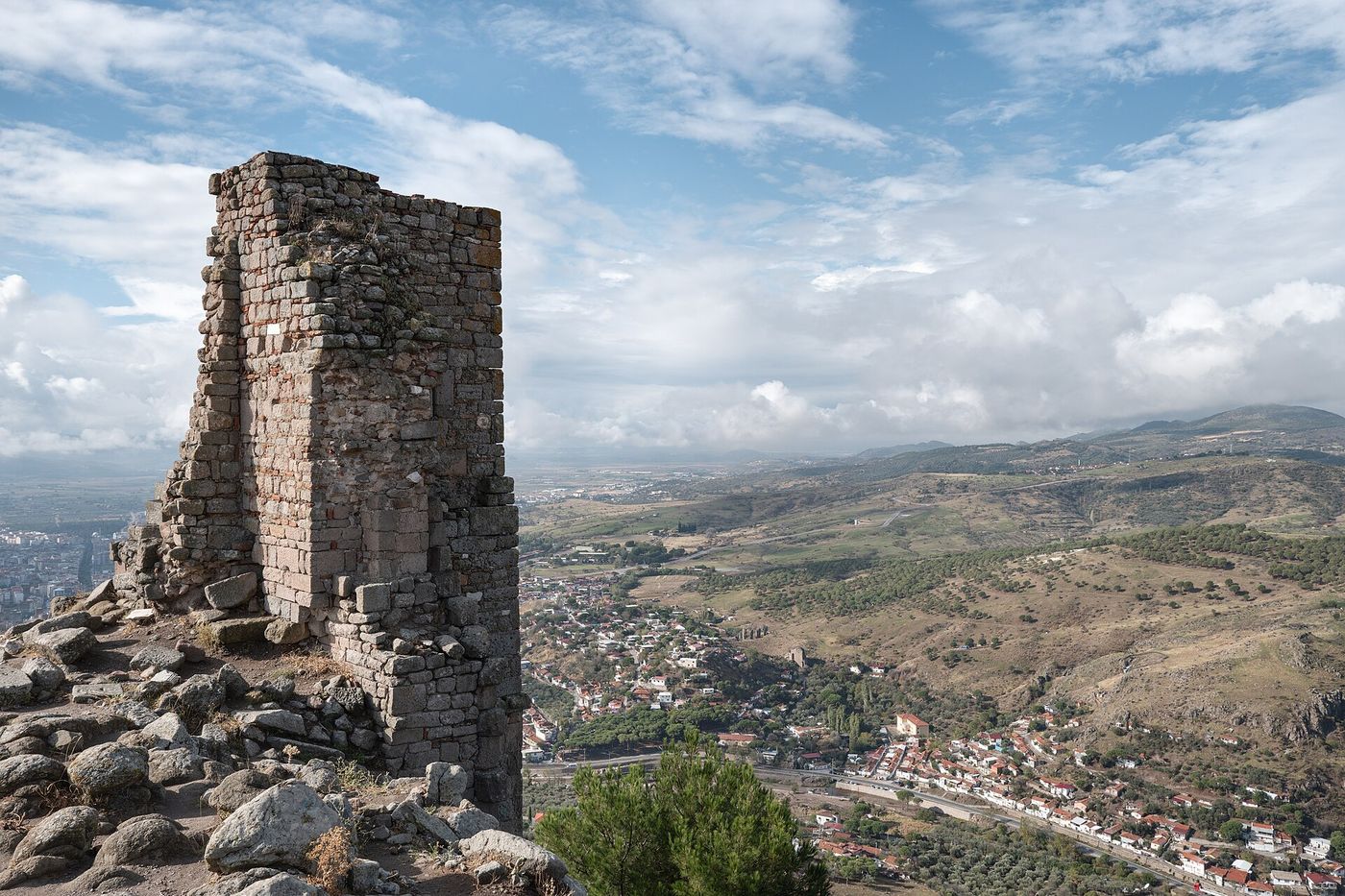
Photo: Giorgio Galeotti (CC BY-SA 4.0)


Common questions
- How long does a group need at the Pergamon acropolis?
- About two and a half hours including the cable car at both ends. The three narration stops come to roughly seventy minutes; the rest is moving between terraces.
- Should a group walk down into the theatre at Pergamon?
- No. It is the steepest theatre of the ancient world, the seating is worn and there is no handrail. Narrate it from the upper terrace, which is also where the view is.
- Is MüzeKart valid at Pergamon?
- Yes. The acropolis is on the Ministry of Culture and Tourism's museum pass list, so pass holders enter without a separate ticket.
- Where is the Pergamon Altar?
- In Berlin. Only the foundation remains on the acropolis, which is why the question is worth answering early rather than at the empty platform.
- Is the Asklepion part of the same UNESCO site?
- Yes. Pergamon was inscribed in 2014 as a multi-layered cultural landscape, and the Asklepion in the valley is one of the components of that inscription.
Related articles
Sources
Facts on this page come from the sources below. Photographs are credited individually.