Hierapolis and Pamukkale
Two sites on one ticket, and they pull a group in opposite directions. The terraces are a barefoot walk with no shade; the ruins are a 1.6 km ancient city on a slope above them.
- Location
- Pamukkale, Denizli
- Type
- Ancient city
- Typical visit
- 3 h
- Walking time
- 2 h
- UNESCO
- World Heritage List, 1988
- Coordinates
- 37.9239, 29.1233
Summarize with AI:ChatGPTClaudePerplexityGrokGoogle AI Mode
Hierapolis and the Pamukkale travertines were inscribed together on the UNESCO World Heritage List in 1988 as one mixed property -- one of the few in the world listed for both its natural and its cultural value. In practice that means your group walks two different sites in one visit, and the transition between them is where a tour usually goes wrong.
The terraces are a barefoot walk over wet stone with no shade at all. The ruins are a Roman and Byzantine city strung along a slope, roughly 1.6 km from the southern terrace edge to the northern necropolis. Nobody covers all of it, and pretending otherwise is how groups arrive at the theatre with nothing left.
The distances that decide the day
Measured between the points a group actually stops at:
The terraces to the Ancient Pool is about 330 m. The pool to the theatre is another 325 m, uphill. The Plutonion sits 130 m from the pool, close enough to fold into the same stop. The museum is 200 m from the top of the terraces. The Frontinus Gate and the north necropolis are a further 800 m and 530 m beyond that -- which is why they belong to a longer visit, not a standard one.
So the workable core is about 800 m of ground with three stops on it. That fits a three-hour visit with the barefoot section included. Adding the north end turns it into a half day.
The barefoot section is a pacing problem, not a comfort problem
Shoes come off for the travertines. That single rule reshapes the whole visit: the group moves slower, it strings out further, and people stop to photograph in places where they cannot hear you. The stone is wet and bright, so nobody is looking up.
This is the part of the day where standing at the front and talking fails outright. Say what you need to say before the shoes come off, and treat the terrace walk as movement rather than narration.
Practical notes
- The property is UNESCO-inscribed as Hierapolis-Pamukkale (1988), covering the ruins and the terraces together.
- Shoes are removed on the travertines; plan the crossing as a slow, spread-out section.
- The Ancient Pool is ticketed separately from the site.
- The theatre is uphill from the pool, and the walk back down is the same climb in reverse.
- The archaeology museum is 200 m from the terraces and works as the indoor stop in the middle of the day.
Which card covers this site and what it costs is on our museum cards page.
Walking order
The order we use, with the time each stop takes at a normal group pace.
The travertine terraces
The white terraces at the south end of the site, walked barefoot.
The Ancient Pool and the Plutonion
The spring-fed pool with fallen columns, and the gas vent 130 m away.
The theatre
The large theatre on the slope, with its restored stage building.
3 stops · 2 h

37.9239, 29.1233
Coordinates are for orientation, not for navigation.
Map data © OpenStreetMap contributors.
Notes for guides
What a guide needs to know before standing in front of a group here. Written from our own field work; where we have not verified something, it is not listed.
- RouteTerraces, then the Ancient Pool and the Plutonion, then the theatre. Uphill first while the group is fresh; the return is downhill on tired legs rather than the reverse.
- Being heardNothing here blocks the wind: the terraces are an open shelf and the theatre is a slope. This is not a site where an unaided voice holds a group across a stop.
- CrowdsThe terraces are the one place where your group mixes completely with everyone else's. People stop where the view is, not where you are.
- TimingThe terraces and the ruins both face the sun with no shade. Late afternoon works; midday on white stone does not.
- AccessThe barefoot section rules out anyone who cannot walk on uneven wet stone. Say so before the group commits to it, not at the edge.
- TipThe Plutonion is 130 m from the pool. Fold it into that stop rather than walking the group out and back for it.
Photographs
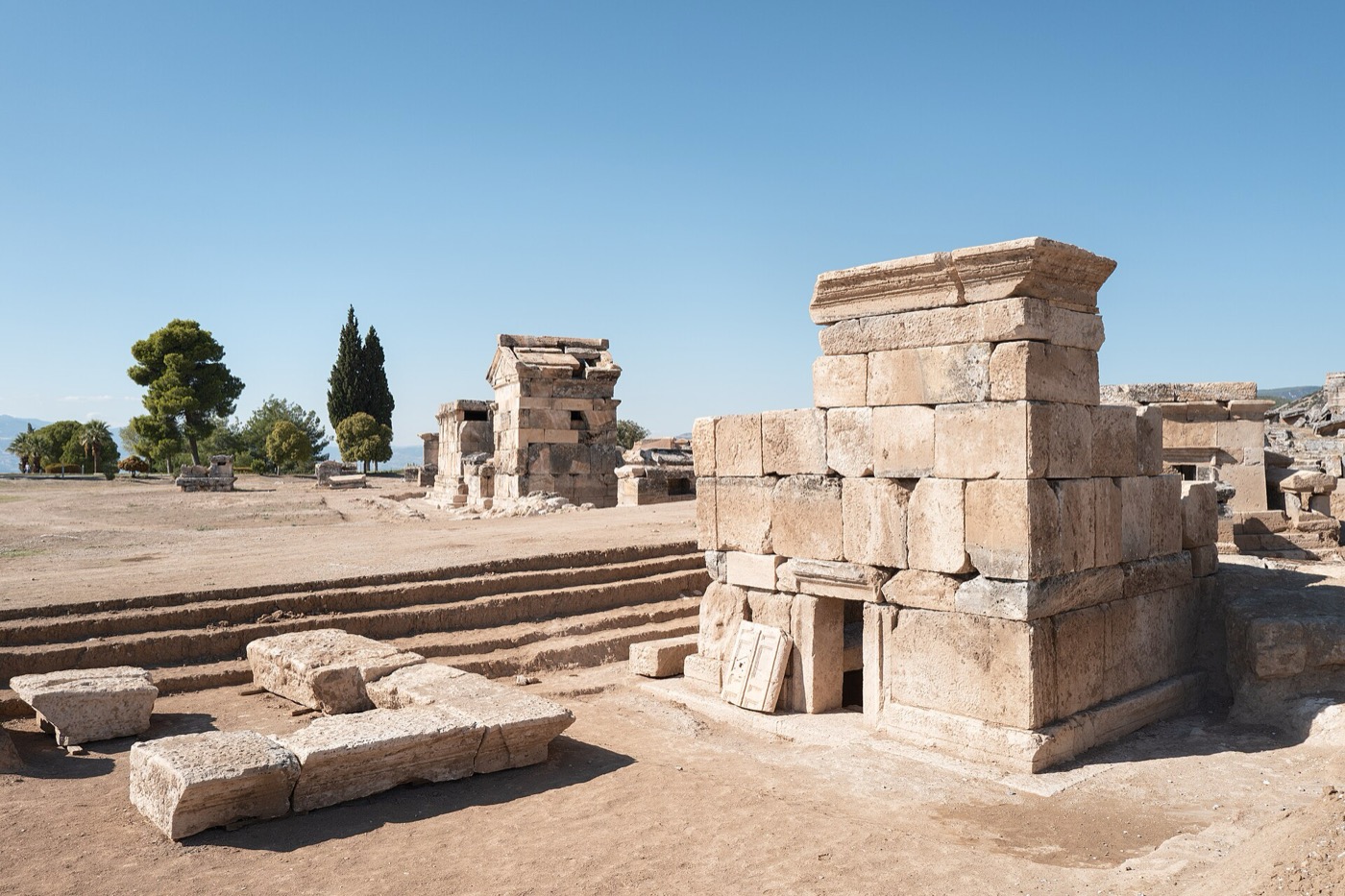
Photo: Giorgio Galeotti (CC BY-SA 4.0)
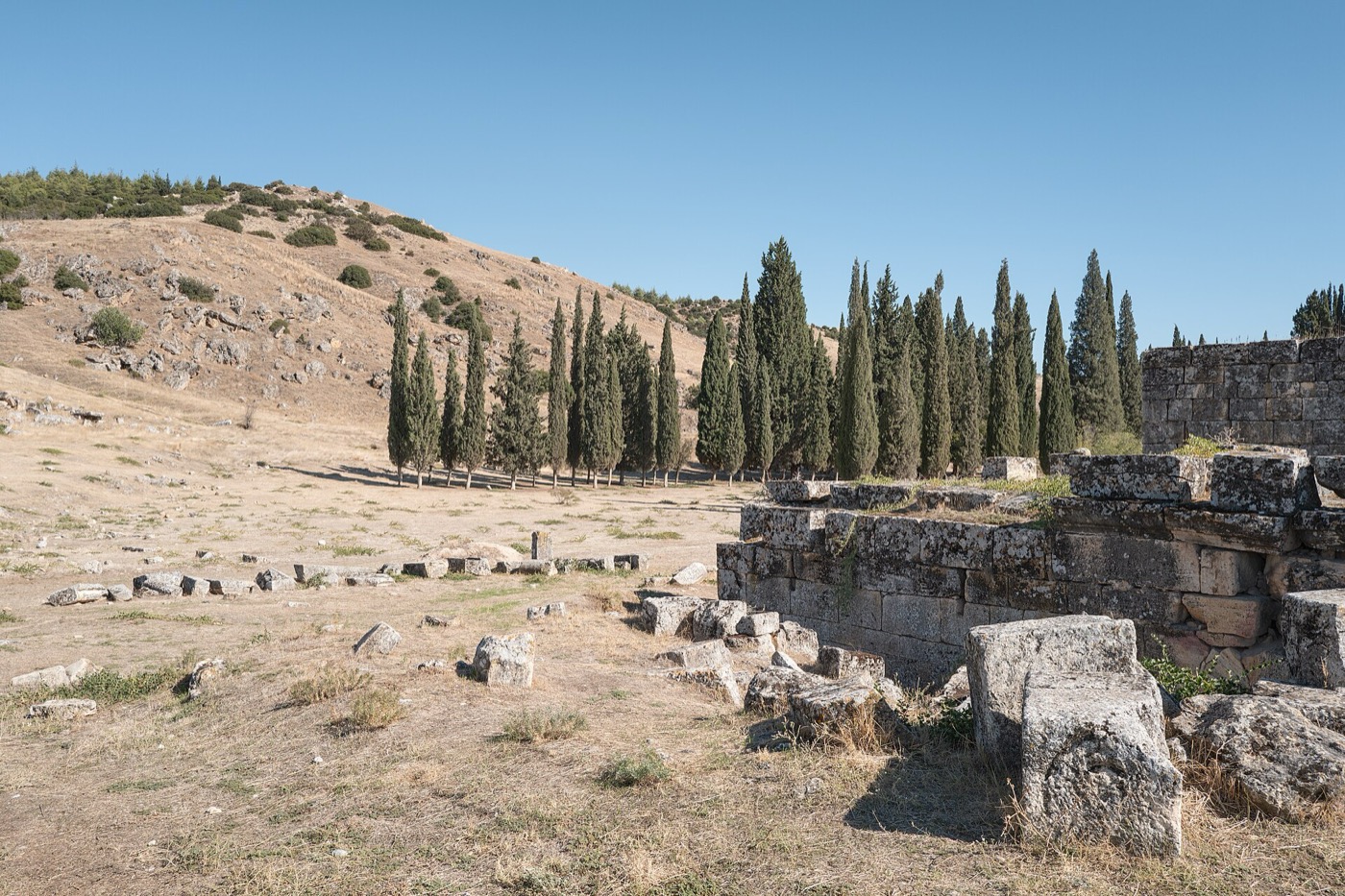
Photo: Giorgio Galeotti (CC BY-SA 4.0)
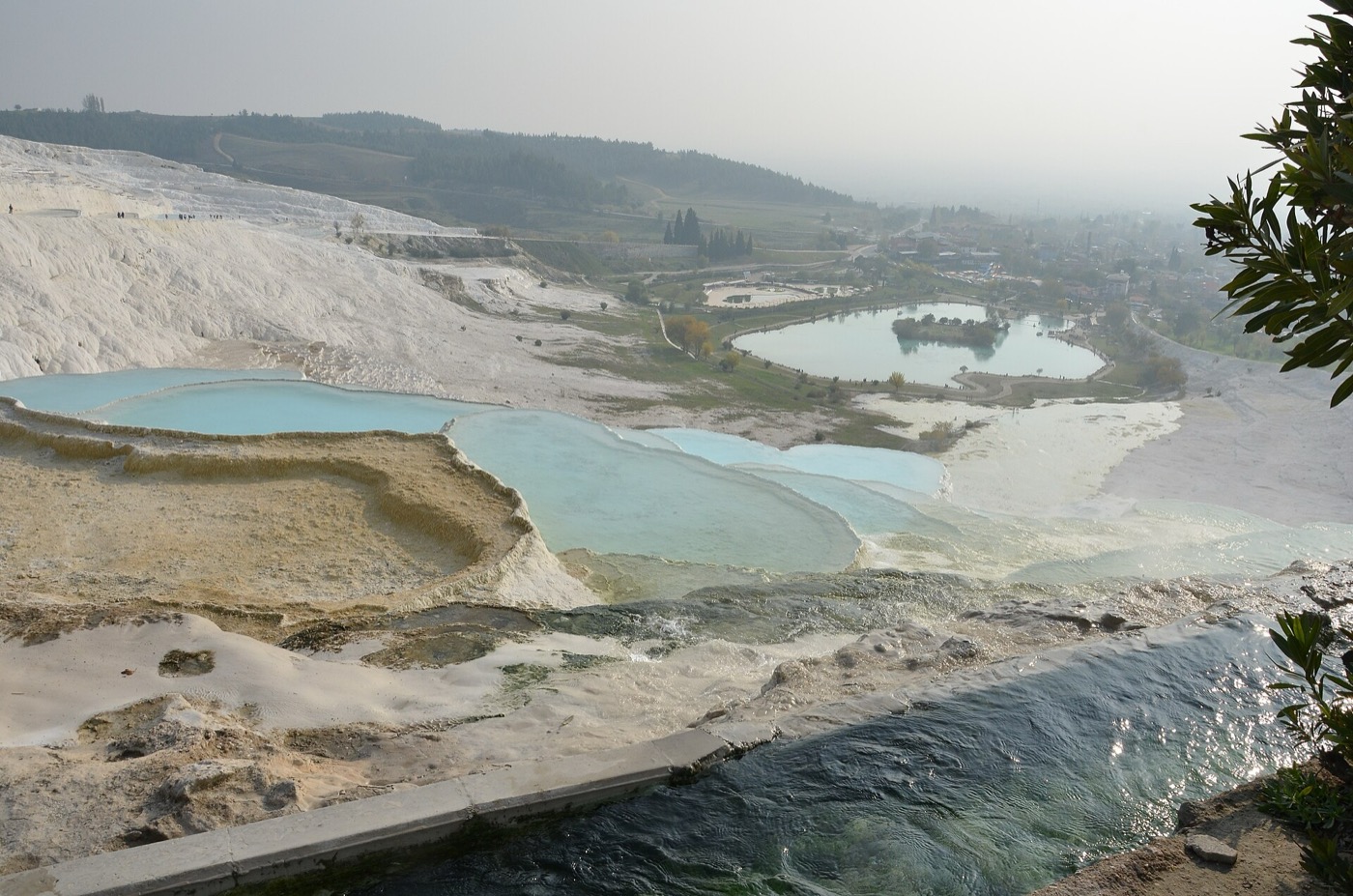
Photo: shankar s. from Dubai, united arab emirates (CC BY 2.0)


Common questions
- How long does a group need at Hierapolis and Pamukkale?
- About three hours for the workable core -- the terraces, the Ancient Pool with the Plutonion, and the theatre. That is roughly 800 m of ground. Adding the Frontinus Gate and the north necropolis makes it a half day.
- How far apart are the main stops?
- The terraces to the Ancient Pool is about 330 m, and the pool to the theatre another 325 m uphill. The Plutonion is 130 m from the pool. The museum is 200 m from the top of the terraces.
- Do you really have to walk barefoot at Pamukkale?
- Yes, shoes come off on the travertines. It changes the pace of the visit more than anything else: the group moves slower and spreads out further, so finish what you need to say before the crossing.
- Is Hierapolis a UNESCO World Heritage Site?
- Yes. Hierapolis-Pamukkale was inscribed in 1988 as a mixed property, listed for both the archaeological city and the travertine formations.
Related articles
Sources
Facts on this page come from the sources below. Photographs are credited individually.