
Didyma
The largest unfinished building of the ancient world, standing in the middle of a modern town. The site is compact enough to keep a group together — the difficulty comes from outside the fence.
- Location
- Didim, Aydın
- Type
- Ancient city
- Typical visit
- 1 h 15 min
- Walking time
- 50 min
- Coordinates
- 37.3850, 27.2564
Summarize with AI:ChatGPTClaudePerplexityGrokGoogle AI Mode
Didyma was not a city but a sanctuary: the oracle of Apollo, second in importance only to Delphi, reached from Miletus along a sacred road roughly sixteen kilometres long. Kings consulted it before going to war.
The temple was among the largest ever attempted in the Greek world. More than a hundred columns were planned, work continued on and off for some five centuries, and it was never finished. Some of the columns still stand unfluted, stopped mid-carving.
Why this site is easier than its neighbours, and where it is not
After Miletus and Priene, Didyma comes as a relief. The site is compact and largely level, the whole sanctuary is visible from the steps, and a group does not fan out looking for the next thing. Most of the visit happens within a hundred metres.
The difficulty is different here. The sanctuary sits inside the town of Didim, with a road, cafés and parking immediately around it, so the background noise is traffic and voices rather than wind across a plain. And the ground is open to the sea: on our August 2026 Aegean field test the onshore wind at Didyma was steady rather than gusting, which is harder to talk over than it sounds, because it does not let up between sentences.
The walk, in the order that works
Begin on the monumental steps, go up into the adyton, then finish at the edge of the sanctuary where the Sacred Way leaves for Miletus.
The steps are the best place to start because they hold a group in tiers instead of a huddle — the same advantage the theatre gives you at Miletus, from a completely different kind of building. The adyton is enclosed and quiet. Ending at the Sacred Way puts the last words of the visit on the road to the next site, which is usually where the coach is going anyway.
What to say, and where
On the steps, explain the scale and the failure: a building begun with more ambition than any city could finish, worked on across five centuries, abandoned incomplete. The unfluted columns are the evidence, and they are visible from where the group is standing.
In the adyton, explain the oracle. This is the room the whole structure exists to enclose, and it is the one place where the walls do something for your voice.
At the Sacred Way, close by connecting Didyma back to Miletus. If the group has already been to Miletus that day, this is where the two sites become one story rather than two stops.
Practical notes
- MüzeKart is valid at Didyma.
- The site is in the centre of Didim, so parking, cafés and toilets are immediately outside it.
- The whole visit fits into a little over an hour, which makes Didyma the natural last stop of a Miletus–Priene–Didyma day.
- Late afternoon light on the stone is the reason many itineraries put Didyma at the end of the day.
- There is very little shade on the temple platform itself.
Didyma is covered by the museum pass. Our museum cards page sets out which card covers what.
Walking order
The order we use, with the time each stop takes at a normal group pace.
The Temple Steps
The monumental stair and the column bases. The steps are deep enough to hold a group in tiers rather than a crowd.
Adyton and the Medusa Relief
The inner court where the oracle was delivered, enclosed by high walls, and the carved Medusa head that became the site's emblem.
Start of the Sacred Way
Where the processional road to Miletus leaves the sanctuary — the closing point of the narration.
3 stops · 50 min

37.3850, 27.2564
Coordinates are for orientation, not for navigation.
Map data © OpenStreetMap contributors.
Notes for guides
What a guide needs to know before standing in front of a group here. Written from our own field work; where we have not verified something, it is not listed.
- RouteStart on the steps and finish at the Sacred Way. Ending at the edge of the sanctuary puts the closing sentence on the road to Miletus rather than in the middle of the ruins.
- Being heardUse the steps as seating. They are deep enough to hold a group in tiers, so the people at the back are above the people in front instead of behind them.
- Being heardThe wind here comes off the sea and holds steady rather than gusting. A steady wind is harder than a gusty one because there is no gap between sentences to speak into; turning the group ninety degrees out of it helps more than raising your voice.
- Being heardThe background noise at Didyma is the town, not the landscape. Road and café noise sits just outside the fence and is loudest on the side nearest the car park.
- CrowdsThe sanctuary is compact and every group uses the same steps and the same adyton. Expect to share both, and plan the long explanation for whichever of the two is free.
- TipPoint out the unfluted columns while explaining that the temple was never finished. It is the one detail that makes five centuries of unfinished work immediately visible.
Photographs
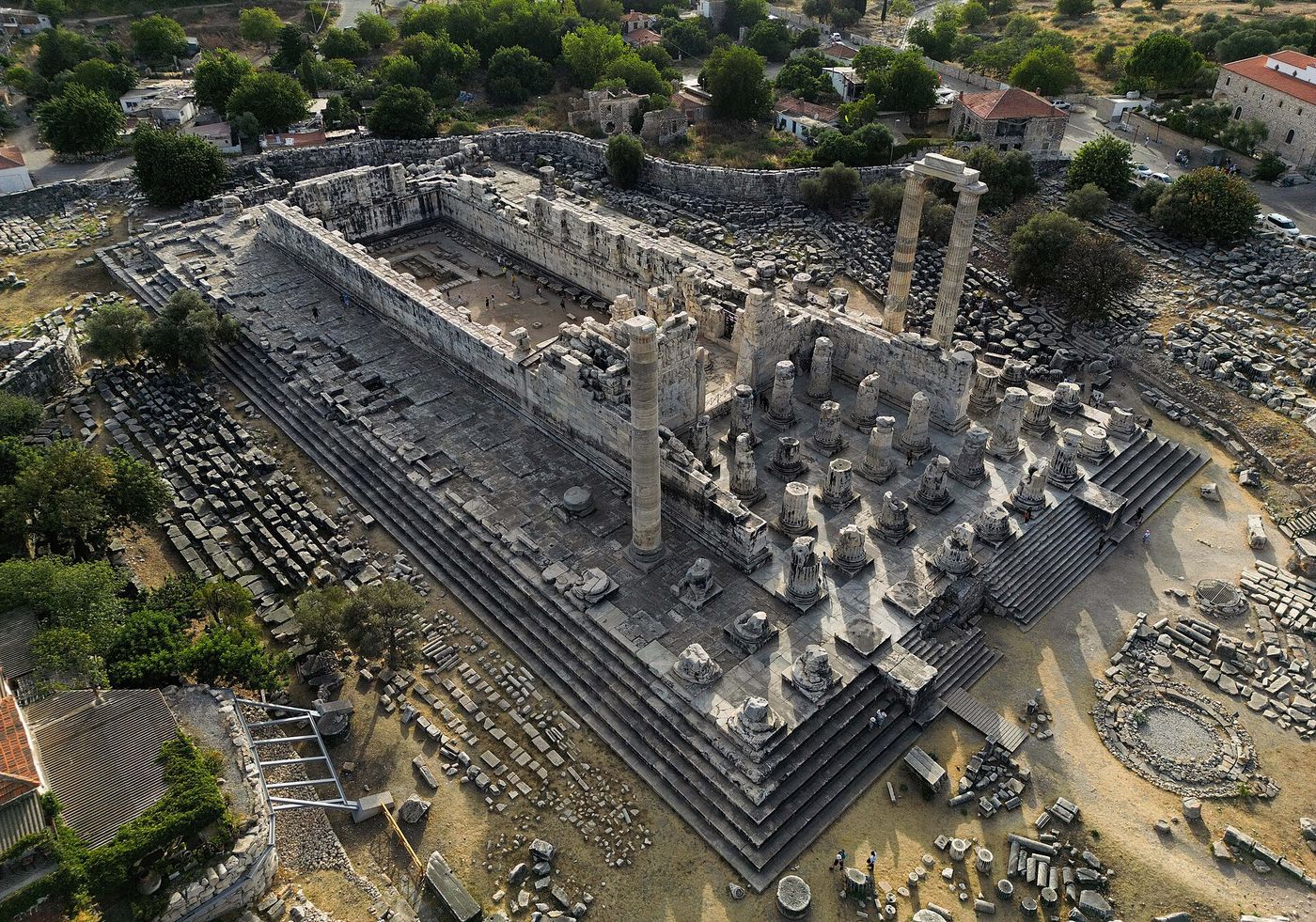
Photo: Rotadefterim (CC BY-SA 4.0)
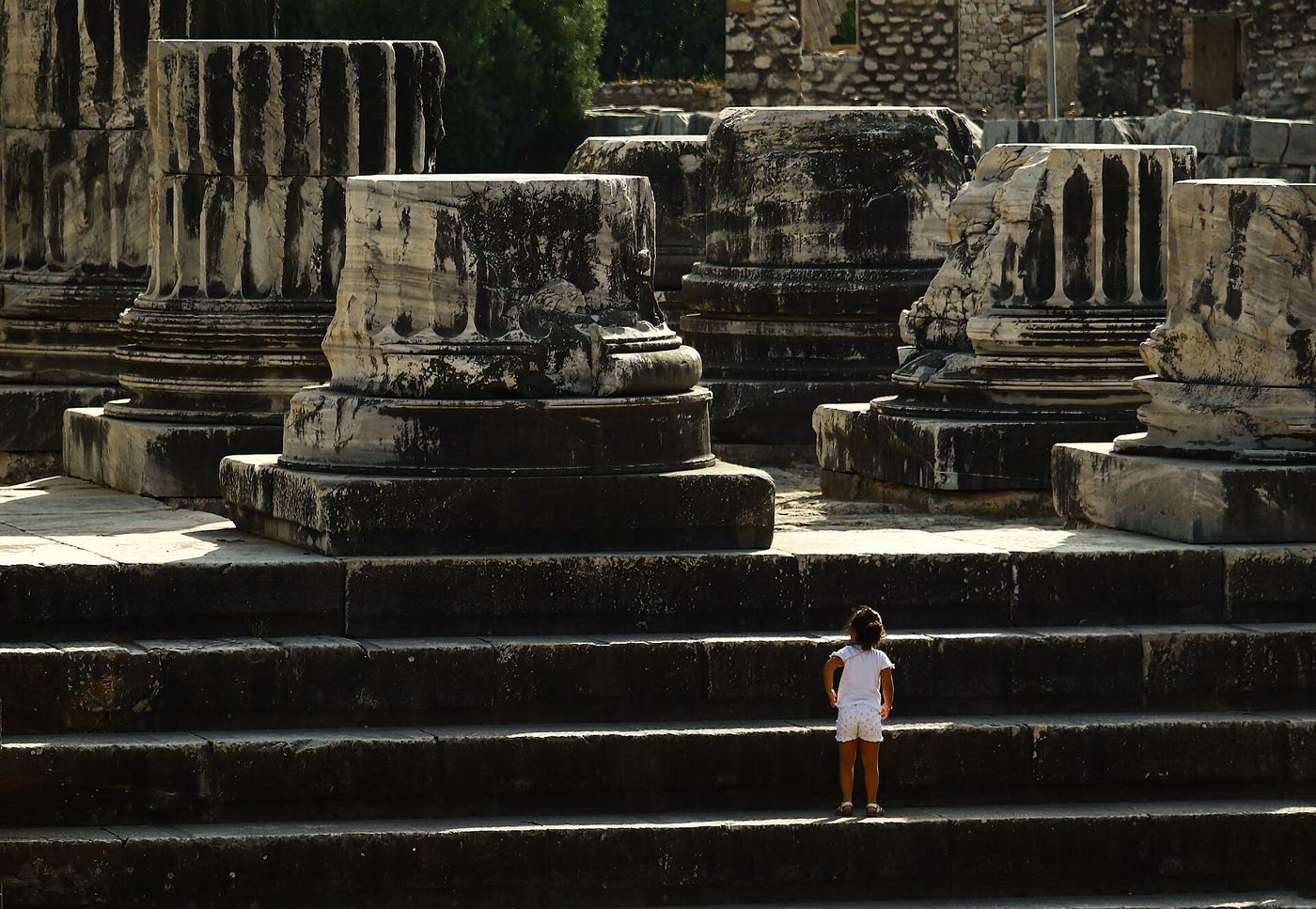
Photo: Rotadefterim (CC BY-SA 4.0)


Common questions
- How long does a group need at Didyma?
- A little over an hour at a normal group pace. The sanctuary is compact and most of the visit happens within about a hundred metres of the temple steps.
- Was the Temple of Apollo at Didyma ever finished?
- No. Work continued on and off for roughly five centuries and stopped with the building incomplete. Several columns were never fluted, which is still visible on site.
- Is MüzeKart valid at Didyma?
- Yes. Didyma is on the Ministry of Culture and Tourism's museum pass list, so pass holders enter without a separate ticket.
- How was Didyma connected to Miletus?
- By the Sacred Way, a processional road of roughly sixteen kilometres. Didyma was the sanctuary of the Milesians rather than an independent city, which is why the two sites belong in the same day.
- What makes Didyma easier to guide than Miletus or Priene?
- Its size. The sanctuary is compact and largely level, so a group stays together without being managed. The trade-off is that the site sits inside a town, so the background noise is traffic and voices rather than open country.
Related articles
Sources
Facts on this page come from the sources below. Photographs are credited individually.