
City walking tours: how to be heard over traffic without shouting
Summarize with AI:ChatGPTClaudePerplexityGrokGoogle AI Mode
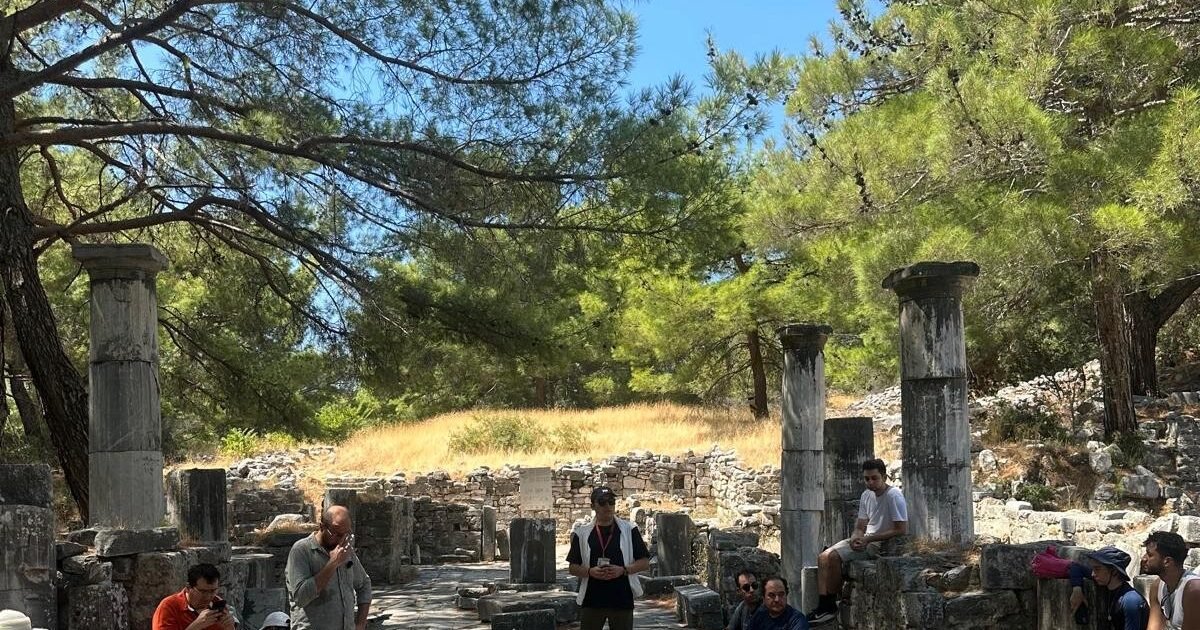
An open archaeological site gives you space and takes away shelter. A city street does the opposite: there is shelter everywhere, but no space, and the ground itself forces your group into the shape that works worst.
On a pavement thirty people become a line ten or fifteen metres long. The person at the far end is outside your voice before traffic is even considered.
Why is a pavement worse than an open field?
Because of geometry, not volume. In the open you can gather a group into an arc two or three people deep, which keeps everyone within a few metres of you. A pavement gives you one dimension. The same thirty people stretch into a line, and the far end of that line is beyond hearing before a single car passes.
The second problem is that half your group ends up with their back to you, because a line has two ends and you can only face one.
Where should you actually stop?
Off the pavement, every time you can. Almost every city route has more options than guides use: a courtyard entrance, an arcade, a square, a building setback, the far side of a parked coach. Any of them converts your line back into a cluster and puts a physical object between the group and the road.
- Scout stops by shape, not by view. A mediocre view where thirty people can stand in an arc beats a great view on a narrow pavement.
- Put a solid object between the group and the traffic -- a wall, a parked vehicle, a row of planters.
- Face the group away from the road so their ears are shielded and their attention is not competing with the street.
- Use the signal cycle. On a controlled junction the quiet interval after a red light is long enough for one key sentence.
- Move the group across the road before you explain the thing on the other side, not while pointing at it.
What about safety, not just audibility?
They are the same problem. A group straining to hear moves toward the guide, and on a street the guide is often standing closer to the kerb than anyone else. People step backwards into the road while looking at you.
When the group can hear comfortably, it stops compressing. That is the least-discussed safety benefit of headphone listening on city tours, and the one guides mention first after trying it.
| Street condition | Effect on the group | What to change |
|---|---|---|
| Narrow pavement | Group becomes a line | Move off the pavement entirely |
| Constant traffic | Steady masking, no gaps | Put an object between road and group |
| Signal-controlled junction | Noise arrives in waves | Time key sentences to the red-light gap |
| Crowded tourist street | Other groups compete | Turn your group so rivals are behind them |
Does a broadcast change how you plan a city route?
It changes stop selection more than anything else. When everyone hears you regardless of where they stand, you can pick stops for sightlines and safety instead of for acoustics -- which on a city street are almost never the same place.
It also lets you keep talking while the group is moving between stops, which on a long street tour recovers a surprising amount of time. Walking commentary is impossible unaided; the front hears it and the back does not.
Frequently asked questions
Is a portable speaker a good solution on the street?
How many people can a guide handle on a city walking tour?
Does the audio work while walking?
Do participants need mobile data?
Pick stops for the view, not the acoustics
The stop-selection habits above work on any tour. If the thing limiting your city route is where your voice reaches rather than where the interesting things are, see how the broadcast works -- and compare it with hardware on the alternatives page.
Sources
Group-shape and stop-selection observations come from our own field tests. Photograph is our own. Local rules on amplification in public spaces vary by municipality; check with the relevant authority for your route.
Places in this post
Related articles
 GuidesGroup tours in Rome with headsets: where your own system works and where it does not (2026)
 GuidesLouvre groups of 7 to 20 must bring their own headsets (2026)
 GuidesVenice requires earphones for tour groups of more than ten (2026)
 GuidesNarrating on a boat tour: engine noise, open water and no signal
 GuidesHeadsets are mandatory for Florence tour groups of more than eight (2026)
 GuidesYour group has scattered across a site. Now what?