
Priene
The textbook of Greek city planning, built on terraces up a mountainside. The plan is the reason to come and the reason your group is never standing on one level.
- Location
- Söke, Aydın
- Type
- Ancient city
- Typical visit
- 2 h
- Walking time
- 1 h
- Coordinates
- 37.6597, 27.2978
Summarize with AI:ChatGPTClaudePerplexityGrokGoogle AI Mode
Priene is the clearest surviving example of the Hippodamian grid: streets crossing at right angles, laid over the slope of Mount Mykale in a single planned act rather than grown over centuries. It is the city plan that every later Greek foundation is measured against.
The Temple of Athena was designed by Pytheos, the architect of the Mausoleum at Halicarnassus. Alexander the Great paid toward its construction, and the inscription recording it is now in the British Museum.
Why this site is hard to guide
Priene is not flat and it is not level. The city sits on terraces, so a group is almost never standing on one plane: some of them are above you on a retaining wall, some are below on the next terrace down, and the ones below cannot see your face.
The ground is also rough. Between the terraces the route is rocky and often stepped, and a group of thirty arrives at each stop strung out over a long interval rather than together. This is the site's real cost in time — not the stops, the gaps between them.
The walk, in the order that works
Enter from the eastern gate and take the climb first, while the group is fresh. The theatre comes first, then the Temple of Athena on the western terrace, then back down and east to the bouleuterion and the agora.
This order puts the two enclosed spaces — the theatre and the council chamber — at the start and the end, with the open, wind-exposed temple terrace in the middle. It also means the group finishes near the way out rather than at the far western edge.
What to say, and where
The theatre is where to explain the plan, because from the seats you can see the grid running away below you: the same street widths, the same block sizes, repeated down the hillside.
The Athena terrace is where to explain the money and the politics — Pytheos, Alexander's contribution, the temple that made a small city visible to the Greek world. Wait for the group to gather before starting: this is the most exposed point on the site and the plain below pulls attention away.
The bouleuterion is where to explain how the city governed itself, and it is also the easiest place on the site to be heard. The seating wraps three sides of a small room, which is precisely what the temple terrace is not.
Practical notes
- MüzeKart is valid at Priene.
- The site is steep and rocky; proper walking shoes are not optional here.
- There is pine shade between the terraces, which Miletus and Didyma do not have.
- Priene is normally the first stop of the day when it is combined with Miletus and Didyma.
- The climb from the eastern gate is the hardest part of the visit and it comes at the beginning.
Priene is covered by the museum pass, so entry is usually already settled before the group arrives. Our museum cards page sets out which card covers what.
Walking order
The order we use, with the time each stop takes at a normal group pace.
The Theatre
The Hellenistic theatre with its front-row marble seats of honour, reached after the climb from the eastern gate.
Temple of Athena
Pytheos' Ionic temple on the western terrace, with the Meander plain opening out below it.
Bouleuterion and Agora
The council chamber, enclosed on three sides by tiered seating, and the city square beside it.
3 stops · 1 h

37.6597, 27.2978
Coordinates are for orientation, not for navigation.
Map data © OpenStreetMap contributors.
Notes for guides
What a guide needs to know before standing in front of a group here. Written from our own field work; where we have not verified something, it is not listed.
- RouteDo the climb first, while the group is fresh, and finish at the bouleuterion. Leaving the ascent for later in the visit turns it into the part people remember.
- RouteName the regrouping point before the climb, not during it. On terraces the group arrives in pieces and the front half will start walking on without an instruction.
- Being heardThe bouleuterion is the one enclosed stop: tiered seating on three sides of a small room. Put the long explanation here, not on the Athena terrace.
- Being heardThe Athena terrace is the most exposed point on the site and faces open plain. This is the stop where an unaided voice loses the back of the group first.
- AccessThe route between terraces is rocky and stepped. A group of thirty will spread across a long interval between stops even at a comfortable pace.
- TipAlexander's inscription is in the British Museum, not on the terrace. Say it at the temple, before someone goes looking for it.
Photographs
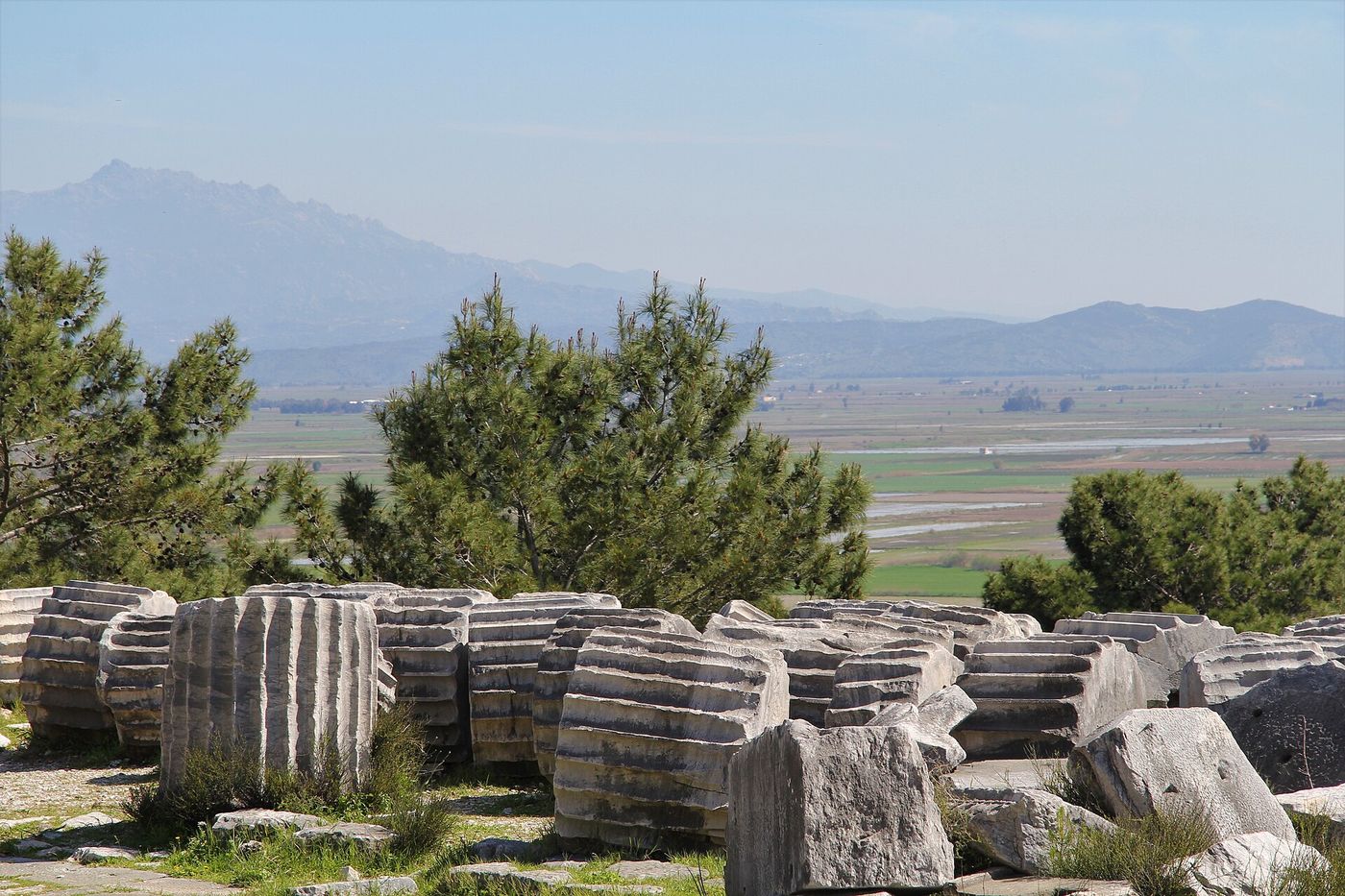
Photo: Rabe! (CC BY-SA 4.0)
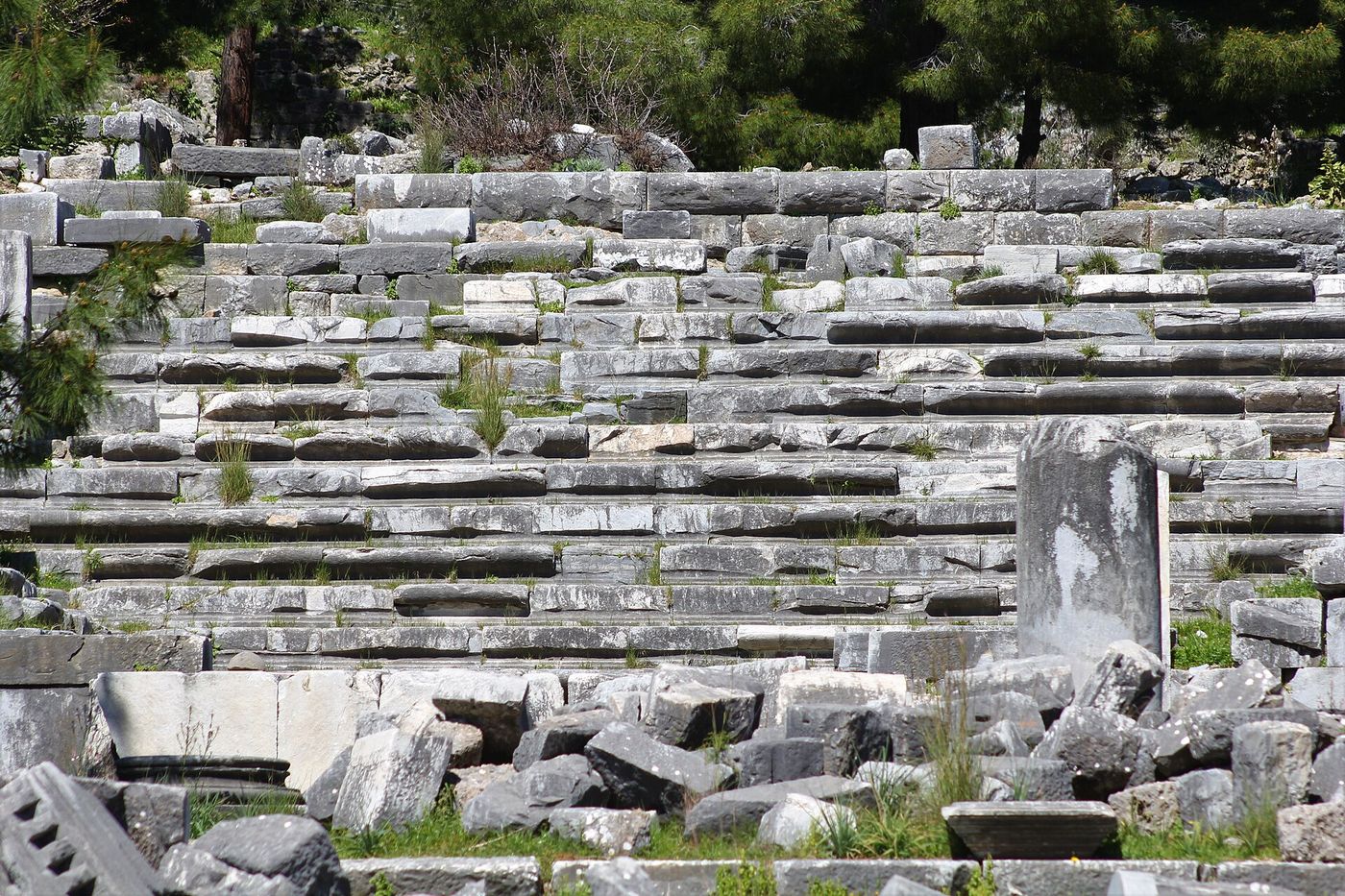
Photo: Rabe! (CC BY-SA 4.0)


Common questions
- How long does a group need at Priene?
- About two hours at a normal group pace. The three narration stops come to roughly an hour; the rest is the climb and the rocky walking between terraces.
- Is Priene difficult to walk?
- Yes, by the standards of the nearby sites. It is built on terraces on a mountainside, the route between them is rocky and stepped, and the climb from the eastern gate comes at the start.
- Is MüzeKart valid at Priene?
- Yes. Priene is on the Ministry of Culture and Tourism's museum pass list, so pass holders enter without a separate ticket.
- Why is Priene famous among ancient cities?
- Because its grid plan survives more completely than anywhere else. The streets cross at right angles across a slope, laid out in one planned act, which makes Priene the reference example of Hippodamian planning.
- Where is the best place at Priene to give a long explanation?
- The bouleuterion. It is a small room with tiered seating on three sides, so it holds a group together and carries a voice — unlike the open Athena terrace above it.
Related articles
Sources
Facts on this page come from the sources below. Photographs are credited individually.